
Flagship product
The perimeter that knows what it is looking at
Intelligent wild animal detection, alert and deterrent system
Most farms already have cameras. What they do not have is anything watching them at 2 AM. Deerkha Drishti is the layer that turns those cameras into a system that sees, decides and acts on its own.
What it does
Six things, done properly
Recognises the animal, not just the motion
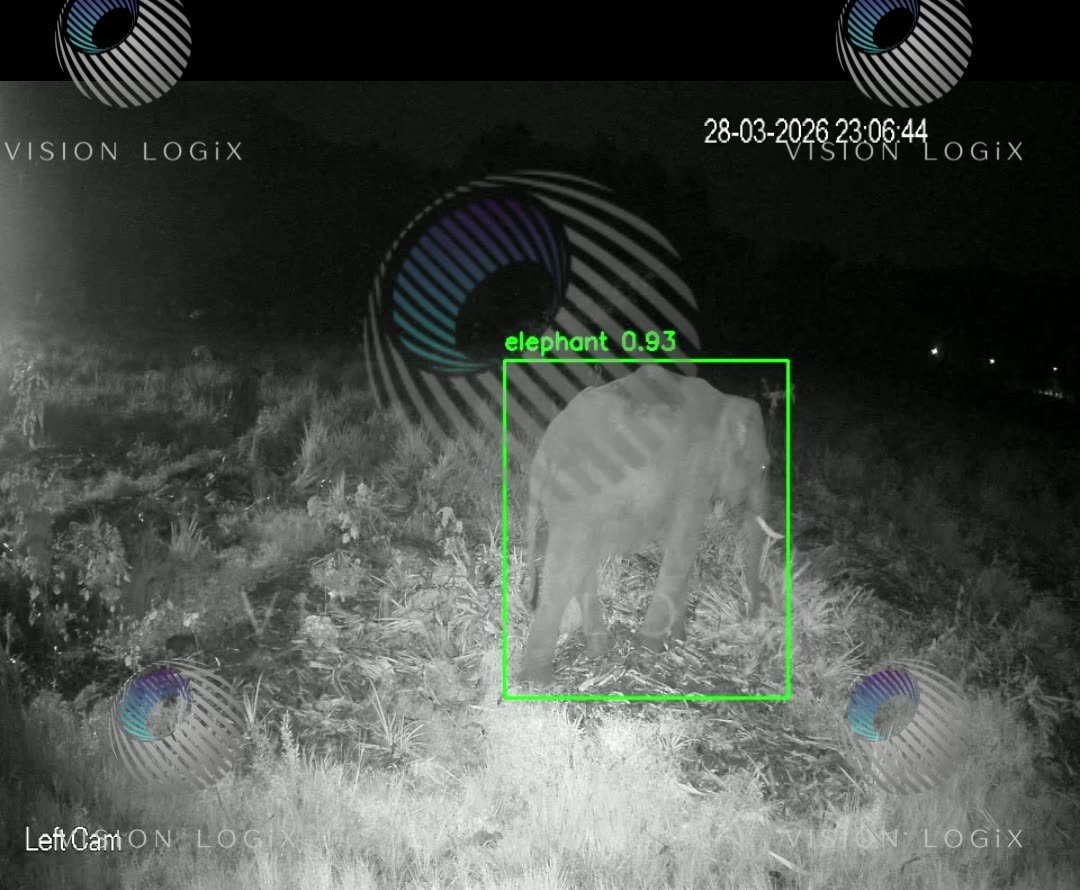
Models trained on real footage from Kerala farmland classify what entered the frame — elephant, wild boar, leopard, deer or person — and a second independent check has to agree before anything is treated as an intrusion. Each class carries its own threshold, and a single animal produces a single alert rather than forty.
Watches only what you tell it to
Detection regions are drawn as polygons over each camera view — the crop, the fence line, the approach path, roughly 80 metres out. Movement outside the region is logged without waking anyone.
Works when the raids happen
Infrared cameras carry the perimeter through the night. The system runs its own day and night profiles on the site clock, because behaviour after 8 PM is not the same as behaviour at noon.
Acts before you can
A confirmed detection closes a relay at the site and fires the strobe-and-audio sequence mapped to that species — because what turns an elephant back is not what should fire at a leopard, or at a person. No human in the loop, no round trip to a server.
Tells the right person, immediately
An annotated snapshot, the species, the camera and the geo location reach your phone within seconds — the owner, the manager, or the forest department, in whatever combination the site needs.
Keeps the evidence
Continuous footage and short event clips are written to storage at the site, indexed by date and camera, with retention managed automatically so the drive never fills. Alert media syncs to the cloud; the archive stays on your ground.
Why it is different
It is a system, not a camera
The detection, the alert and the deterrent are one product, integrated with the Vision Logix platform. Clients get live video feed and notifications from the same place — the same dashboard, the same history, the same login — instead of stitching together a camera app, a messaging group and a siren.
- Live view of any camera, on demand, from a phone
- Full detection history with the frame that triggered it
- Per-camera configuration pushed from the dashboard to the site
- Detections from the field used to retrain and sharpen the model
Who it is for
Where the loss actually happens
Farms and plantations
Pineapple, banana, paddy and rubber holdings on the edge of a wildlife corridor, where a single night can take a season.
Forest departments
Perimeter monitoring with a verifiable record — timestamped, species-tagged and geo-located — rather than a phone call after the fact.
Estates and institutions
Resorts, campuses and townships near forest boundaries that need early warning without staffing a control room.
Deployment
What goes on the ground
- Cameras
- Up to eight day/night cameras with infrared, placed during survey and kept on a network segment of their own. Existing cameras can often be reused.
- The on-site unit
- One sealed, actively cooled cabinet sitting between the camera network and the site's internet connection. It watches, recognises, records, alerts and fires the deterrent.
- Deterrent hardware
- A relay board driving the audio amplifier and lights, wired to cover the approach the cameras watch.
- Connectivity
- Any ordinary internet connection, outbound only. No port forwarding, no static IP, no exposed camera. The cameras themselves never reach the internet at all.
Tell us about the site
Acreage, the animals you are dealing with, and what cameras are already installed. That is enough for us to tell you what a deployment looks like.