
Pilot — Kerala
A ten-acre pineapple farm in Vadasserikkara
The farm had lost close to ₹50 lakh in a year to elephants trampling the crop. Solar fencing, noise-makers and other traditional deterrents had all been tried and abandoned before we arrived.
- Site
- Ten-acre pineapple farm, Vadasserikkara, Kerala
- Cameras
- Three, installed at the centre of the property
- Prior losses
- ≈ ₹50 lakh in the preceding year
- Species logged
- Elephant, wild boar, deer
- Peak activity
- Most intrusions after 8 PM
- Duration
- Multiple nights of continuous monitoring
What we installed
Three cameras at the centre of the property, an edge box in a cooled cabinet, and a relay-driven sound and light deterrent covering the approach. Detection regions were drawn roughly 80 metres out from each camera, over the ground that mattered rather than the whole frame.
What it found
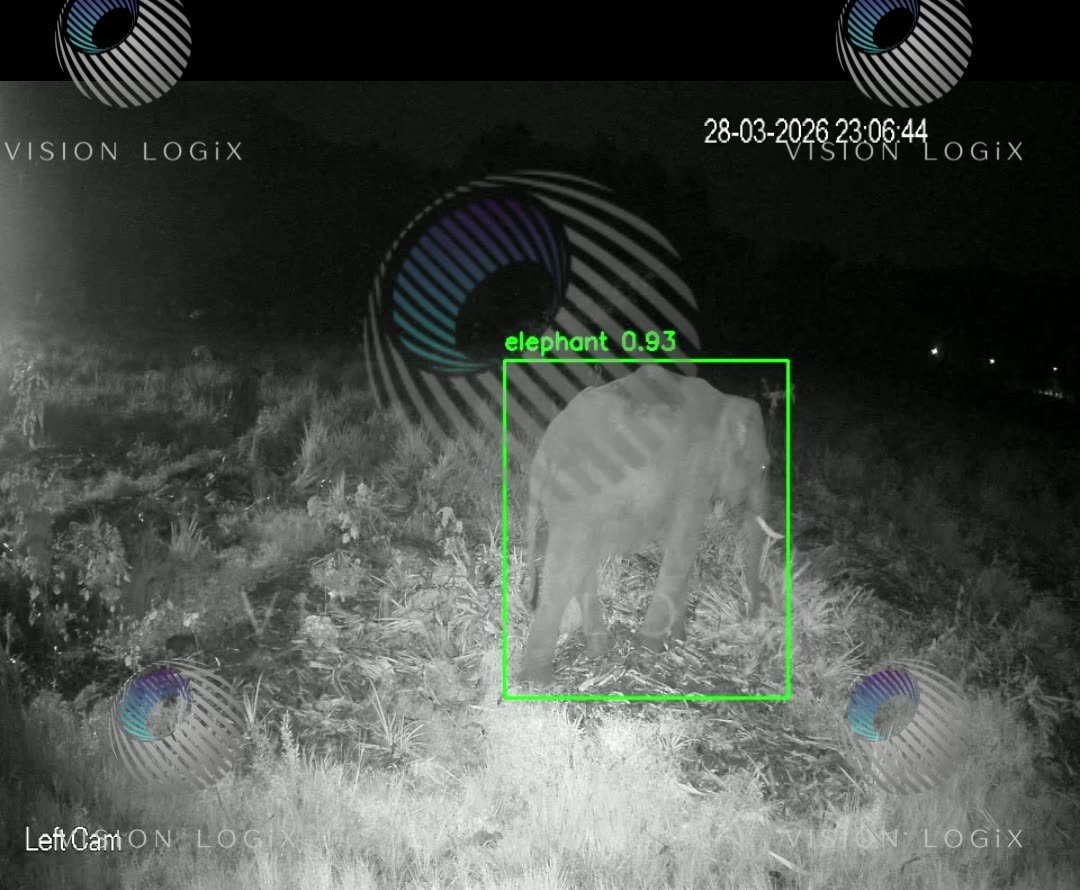
The system logged elephants, wild boars and deer across multiple nights. Most intrusions began after 8 PM, which is the window the site had no practical way to cover. Each detection carried the annotated frame, the species, the camera and the time — a record rather than a recollection.
What we changed because of it
Data collected from real detections at the farm was used to retrain and refine the model, improving accuracy and reducing false triggers. That loop is the reason the pilot mattered more than a lab benchmark: grass, rain, insects and moving shadows do not appear in a training set until a real site produces them.
The result
With just three cameras installed in the centre of the property, the results were compelling enough to prove the concept and move Deerkha Drishti from a prototype to a product.